
DETA’s Carbon Footprint

The Deta Carbon Footprint
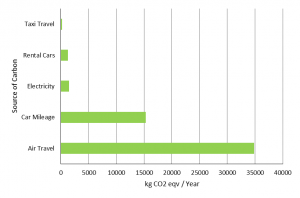
Previously we’ve discussed What is your carbon footprint and why it matters…? It seemed like a natural progression for us to complete one for ourselves. We followed the structure set out by Ministry of the Environments guiding Document (Link) and ended up with the following:
Source Of Carbon Chart | Deta

Getting from place to place is clearly our biggest impact on the environment thanks to both Air Travel and Car Mileage. But the good news is that moving forward the car mileage emissions should be reducing steadily as more and more trips are being taken in the more efficient and environmentally friendly Deta-mobiles than our personal cars. This was definitely a factor that influenced the choice of car and why a gas guzzling Ute was not chosen despite the protests of some off-road enthusiast members of the team.


In total, we calculated that the actions of Deta produced 53 tonnes a year of carbon dioxide and to mitigate this we would have to plant a around 1.4 Ha of five-year-old pine trees. While we’ve marked out a nice corner of Hagley Park for this, it seems unlikely that it would fly with the council… So, if you have a better idea about how to tackle this or how your company is reducing its carbon footprint we’d love to hear it.

Aerial view of an industrial plant at sunset with a superimposed digital data graph overlaying the facility.
1 April 2026
Discover how the 2026 EECA report identifies a $3B opportunity in demand-side flexibility (DSF). Learn how industrial sites can avoid $500/MWh peak energy costs.
Industrial plant with smokestacks against a bright blue sky, some trees in the foreground.
22 February 2026
Is an LNG terminal the solution to NZ’s gas shortage? Discover a smarter energy mix for security, firming power generation, and industrial transition.
Engineers in safety vests pointing at a laptop screen; helmets, notepad, and phone on table.
19 February 2026
Stalled by budget cuts? Learn how to fund industrial efficiency and decarbonisation projects using OpEx savings, Energy Performance Contracts, and 2026 grants.
Show More