
The Crisis You Can't Afford to Waste: Why New Zealand Industry Must Move Beyond Diesel — and What It Means for Gas
The global energy landscape has shifted dramatically over the six months and New Zealand industry is feeling it. Diesel prices have lurched unpredictably. Supply chains that once hummed quietly in the background have become front-page news – whether its internationally traded commodities like diesel and petrol, or local fuels such as natural gas — a reality that would have seemed extraordinary just a few years ago.
But within this disruption lies a genuine opportunity. The businesses that use this moment to accelerate their transition away from fossil fuels won't just be doing the right thing for the planet — they'll be building a more resilient, lower-cost operation for the decade ahead.
The Diesel Question: Risk Without the Reward
Let's be honest about where we stand with diesel in New Zealand.
The good news is that physical supply has proven more robust than many feared. New Zealand's position as a small player in a large global market — reliant on a steady stream of modest-sized tankers — has, counterintuitively, provided a degree of insulation. There has been no dramatic national shortfall. The pipeline has largely held.
The bad news is that price is another matter entirely. Diesel costs have remained stubbornly elevated, driven by the difficulty of extracting and moving crude from conflict-affected regions. And there's no credible scenario in which global diesel pricing returns to the comfortable lows of the previous decade. The structural pressures — geopolitical instability, decarbonisation policy, shifting refinery capacity — are not going away.
So the risk profile of diesel dependency looks like this: supply disruption is possible but has proven manageable; price escalation is near-certain and already here. For any business that relies on diesel for process heat, backup generation, or transport, that combination should be deeply uncomfortable.
LNG Debate: Are We Looking at the Right Problem?
New Zealand is currently weighing whether to build an LNG import terminal to shore up gas supply as domestic fields decline. It's a debate that deserves careful scrutiny.
Those who favour an LNG terminal argue it preserves optionality, keeps gas available for industrial users, and manages the dry-year electricity risk that looms over our hydro-heavy grid. These are legitimate concerns.
But there is a stronger argument on the other side.
Building an LNG import terminal is an expensive, long-lived piece of infrastructure that locks New Zealand into global gas markets — markets that are tightening, politicised, and increasingly expensive. Not to mention, more risky than they’ve been in living memory. The capital required to develop that terminal is substantial. And crucially, that same capital could instead be directed toward electrification, renewable heat, energy storage, and efficiency — investments that reduce exposure to volatile international commodity markets rather than deepen it.
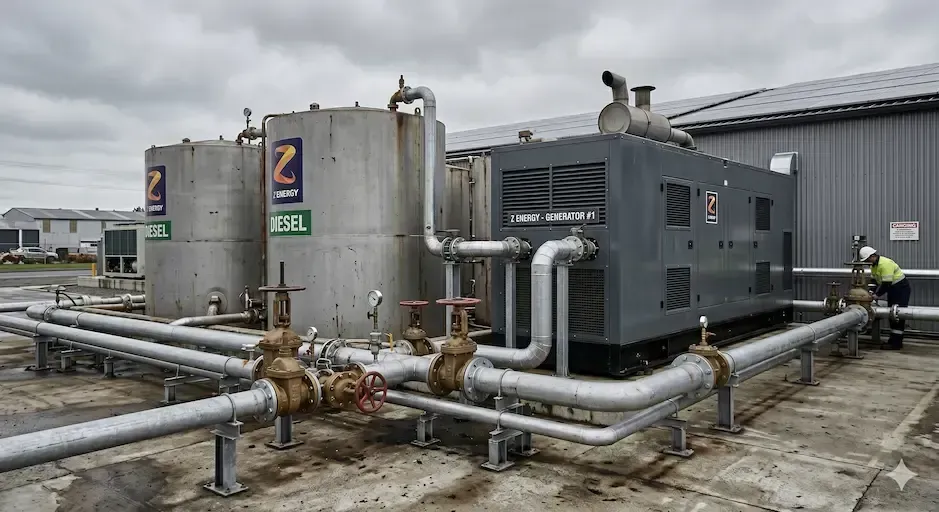
The dry-year electricity risk is real, but diesel generation already exists as a viable short-term backstop. Rather than committing to the cost and complexity of LNG import infrastructure, the more prudent path is to use existing diesel capacity as a bridge while systematically reducing overall energy demand and building out renewable alternatives.
The difference is this: one path buys us more time in the fossil fuel system. The other buys us a way out of it.
Natural Gas in New Zealand: Writing on the Wall
Whatever one's view on LNG imports, the trajectory of New Zealand's domestic natural gas market is not ambiguous. The Maui and Pohokura fields are declining. New exploration has slowed. The most recent MBIE stocktake indicates the lowest reserve volumes since records began. Without some step change, the supply of locally-produced gas will continue to contract.
What does that mean for price? History is instructive. When supply shrinks in a market with sticky demand, prices rise — often sharply and discontinuously. We have already seen this dynamic begin to play out in New Zealand's gas market, and the disruption to global energy supply chains over the past two years has provided a vivid preview of what price escalation looks like when it arrives suddenly. With the impending exit of Maui, and therefore Methanex, this price fluctuation will become ever more present, and potentially extreme.
For businesses currently reliant on natural gas — for process heat, space conditioning, or other thermal applications — this is the environment in which their investment decisions need to be made. A feasibility study conducted under today's gas prices may look very different from one conducted under prices five years from now. The businesses that model this risk honestly, and act on it, will be in a fundamentally stronger competitive position.
The Opportunity in the Crisis
Here is the practical point for New Zealand industry: right now, while diesel prices are high and the energy transition narrative is front of mind, the business case for alternatives has never been stronger.
High fossil fuel prices compress payback periods for efficiency investments. They make electrification economics look compelling. They make it easier to get internal sign-off for capital expenditure on heat pumps, electric process equipment, solar PV, and demand management systems. The CFO who wouldn't look at a renewable heat project at $0.80/litre diesel will look very differently at the same project at $1.60/litre. This is the reality of the current market. But the same holds true for natural gas – its just a little delayed.
This is the moment to build those business cases. To commission those energy audits. To get the numbers on paper so that when the capital allocation conversation happens, the data is ready.
The crisis is temporary – but it won’t be the last one. The infrastructure decisions made during it, and as a result of it, are not.
What This Means for Your Business
The practical priorities for New Zealand industrial operators right now are:
- Understand your energy baseline. Many businesses have never conducted a rigorous energy audit. Without knowing where energy is used, how much, and at what cost, it is impossible to prioritise action. A comprehensive audit — covering electricity, thermal energy, and fossil fuels — is the essential first step.
- Model the commodity risk. Build scenarios that stress-test your energy cost exposure under different price trajectories for diesel, gas, and electricity. The businesses that have done this work are not surprised by the current environment — they were prepared for it.
- Prioritise investments that reduce fossil fuel exposure. Not every efficiency opportunity is equal. Opportunities that reduce diesel or gas consumption deserve a premium in your capital allocation framework, because they reduce exposure to markets that are structurally likely to become more expensive.
- Use the current moment to make the case. High energy prices are uncomfortable, but they are also an argument. Use them to accelerate internal conversations about electrification, renewable heat, and energy sovereignty.
The Bigger Picture
New Zealand has a genuine opportunity to build an industrial energy system that is less exposed to the whims of international commodity markets, more resilient to geopolitical disruption, and progressively lower in carbon. The ingredients are there: abundant renewable electricity potential, a sophisticated engineering sector, and a business community that increasingly understands the risk of standing still.
The current energy crisis is not a reason to panic. But it is a very good reason to act. The businesses that treat it as a planning failure to be survived will find themselves back in the same position the next time a conflict disrupts a shipping lane or a weather event tightens the electricity market. The businesses that treat it as a strategy signal to be acted on will be in a fundamentally different place when that next crisis arrives.
The question is not whether the energy transition is coming to New Zealand industry. It is whether your business is leading it or being dragged along by it.
DETA Consulting works with New Zealand and Australian businesses to identify energy efficiency opportunities, build investment-grade business cases, and deliver projects through to commissioning. If you'd like to discuss what fuel switching could look like for your site, get in touch at with our Energy Consultants and Engineers.
What we do