
Mapping The Pathway From Industrial Gas To Low-Carbon Process Heat
Decarbonising a single industrial site is complex. Understanding how an entire manufacturing sector can transition away from natural gas is a different challenge altogether.
DETA was engaged by the Nature Conservation Council of NSW (NCC) to build a comprehensive picture of natural gas use across small-to-medium enterprise (SME) manufacturing in New South Wales and identify practical pathways for reducing it.
Drawing on our team's hands-on experience working directly inside industrial facilities, the study moved far beyond high-level emissions modelling. We took a bottom-up, process-engineering approach. We examined how natural gas-fuelled process heat is actually being used in manufacturing, the exact temperatures and processes involved, which technologies could realistically replace gas combustion, and the commercial and infrastructure barriers affecting businesses as they make long-term utility investments.
The result was a sector-wide decarbonisation roadmap connecting real-world industrial thermal duties, renewable technology options, replacement economics, electricity distribution networks, and policy settings.
The Challenge: A Major Emissions Footprint Falling Through The Policy Gaps
The study identified 14.5 Petajoules (PJ) of annual natural gas consumption across the SME-dominated manufacturing sectors examined in NSW, representing approximately 771 kilo tonnes of CO2e (ktCO2e) every year.
Yet, because these sites are individually smaller than heavy industrial polluters, they generally sit outside federal compliance mechanisms like the Safeguard Mechanism.
Individually, these businesses are moderate emitters; collectively, their fossil fuel use is massive. Prior to this study, there was no clear, empirical picture of how these mid-tier manufacturers could practically transition off gas without risking operational continuity.
Building The Picture From The Process Up
Rather than applying a single, generic technology assumption across all of industry, DETA built the transition framework directly from underlying site thermal duties:
Sector → Process → Heat Requirement → Technology → Economics → Adoption → Infrastructure/Policy
This detailed methodology involved:
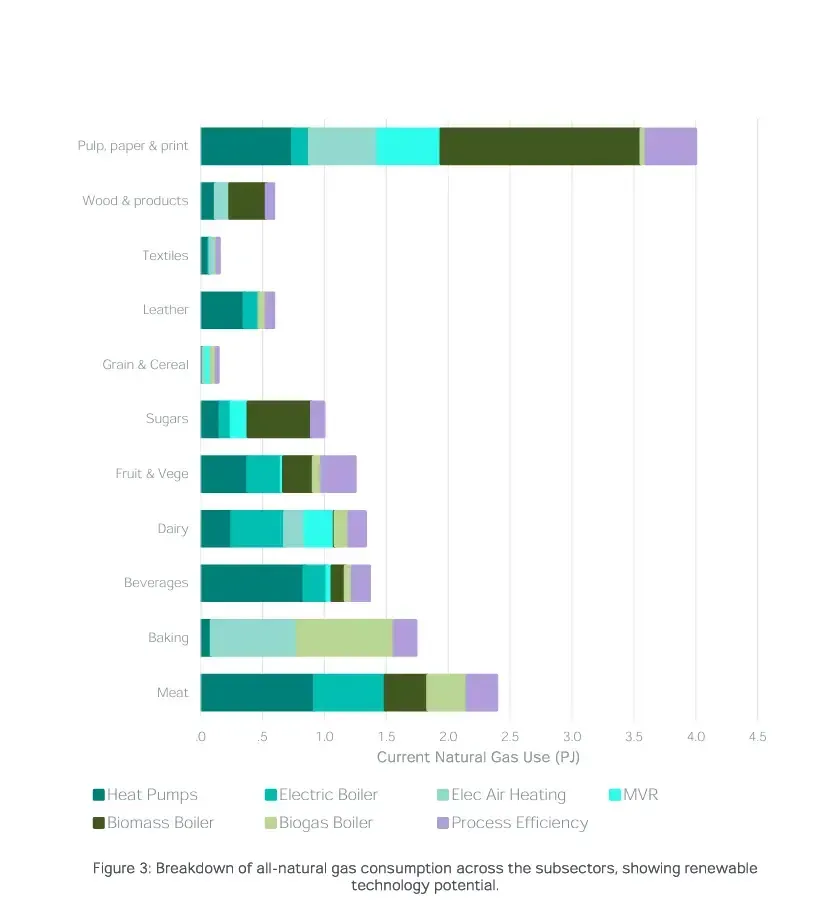
- Mapping Gas Demand: Quantifying natural gas consumption across four major manufacturing sectors—Food and Beverage, Textiles and Leather, Wood Products, and Pulp, Paper and Printing—and their underlying subsectors.
- Disaggregating Thermal Duties: Breaking site demand down into hot water, hot air, and steam applications spanning process temperatures from 30°C up to 300°C.
- Evaluating Technology Matchups: Assessing the technical potential of high-temperature heat pumps, electric boilers, electric air heaters, Mechanical Vapour Recompression (MVR), biomass, biogas, and process efficiency measures against specific process tasks.
- Commercial Financial Modelling: Incorporating technology efficiency coefficients, capital expenditure (CapEx), ongoing operating expenses (OpEx), and commercial investment hurdle rates.
- Modelling Real-World Adoption Curves: Simulating slow, expected, and rapid adoption scenarios rather than assuming technically feasible projects would automatically proceed.
- Testing Policy Levers: Modelling how grid readiness, targeted capital co-funding, demand flexibility, workforce development, and knowledge sharing can alter the overall pace of transition.
Key Insight: There Is No Single Pathway For Industrial Decarbonisation
The study demonstrated that the most practical decarbonisation pathway is determined by how heat is used on site, not simply by the sector a business operates in.
- Low-Temperature Hot Water (Up to 90°C): Washing, cleaning, and pasteurisation duties are exceptionally well suited to high-efficiency industrial heat pumps.
- Evaporation And Drying: Process steps in food, dairy, and pulp/paper create major opportunities for Mechanical Vapour Recompression (MVR) to capture and re-compress waste steam.
- High-Temperature Steam & Direct Heat (100°C to 300°C+): Present distinct engineering challenges, with solutions depending on site spatial constraints, electrical grid transformer capacity, and local access to sustainable biomass or biogas.
Crucially, technical feasibility does not automatically translate into commercial project execution. Existing site infrastructure, electricity tariffs, network connection capacity, capital costs, hurdle rates, and local workforce capability ultimately dictate whether a project proceeds
Key Results: Catalysing Private Decarbonisation Investment
The study proved that coordinated policy intervention and targeted capital support can fundamentally alter the decarbonisation trajectory of SME manufacturing:
- 360 ktCO2e Additional Annual Emissions Reductions: Achievable by 2050 under a coordinated policy framework compared to business-as-usual.
- 7.5 PJ Additional Gas Reduction: Cutting total SME fossil gas consumption from 14.5 PJ down to 3.1 PJ by 2050.
- Over $200 Million In Private Investment Catalysed: Modelling indicated that up to $70 million in targeted capital support would unlock over $200 million in private co-investment across regional manufacturing assets.
Why Sector-Wide Energy Analysis Matters
Industrial energy transition decisions are increasingly being made above the individual-site level.
Governments require empirical data to design effective co-investment levers. Electricity network providers need credible forecasts of future electrical loads to prevent grid connection bottlenecks. Industry bodies need to understand common operational barriers across their member bases. And individual site managers benefit from seeing which technologies are proving viable in comparable process duties.
DETA combines site-level process engineering experience with macro energy modelling to bridge these worlds—ensuring sector roadmaps are grounded in how industrial facilities actually operate.
Download The Full 56-Page Technical Decarbonisation Roadmap
Gain complete access to the research paper prepared by DETA for the Nature Conservation Council of NSW. The full report includes detailed subsector energy breakdowns, technology adoption curves, grid infrastructure readiness analyses, and policy recommendations.
Please fill in your details below to instantly unlock the full PDF download link:
Industrial Gas To Low-Carbon Process Heat
Discuss Your Sector Or Site Decarbonisation Strategy
Whether you represent an industry body looking to roadmap sector-wide decarbonisation, or a plant manager evaluating gas replacement options, speak directly with DETA’s independent process engineering team.
What we do