Industrial Decarbonisation: What Should Australian Businesses Be Doing Now, Next, And Later?
DETA recently attended the Australian Alliance for Energy Productivity (A2EP) Industrial Decarbonisation Conference. Across presentations, panel discussions, and networking sessions, one message was consistently reinforced:
Many industrial sectors are fully aware of decarbonisation technologies, but struggle to overcome the financial barriers required to deploy them successfully.
We saw this reflected firsthand in an interactive survey at the conference, where attendees were asked to identify the single biggest barrier to industrial electrification and decarbonisation. More than 60% of all votes related directly to financial hurdles, including upfront capital costs, energy prices, long payback periods, and insufficient government incentives.
This is a challenge DETA encounters regularly across Australia and New Zealand. In many cases, organisations already have a sound understanding of their decarbonisation opportunities and the technical plant required to deliver them. The core challenge is building robust projects that can successfully compete for capital internally, align with daily operational requirements, and deliver acceptable commercial returns.
Crucially, these challenges are not unique to any one industry. Through DETA's sectoral research with the Australian Meat Processor Corporation (AMPC), the Australian Dairy Products Federation (ADPF), and the NSW Nature Conservation Council (NCC), we continue to identify significant opportunities for emissions reduction that are constrained by these exact commercial and implementation barriers.
A Practical Decarbonisation Roadmap
Leading organisations progressing decarbonisation successfully are not relying on a single silver-bullet technology, grant programme, or one-off capital project.
Instead, they follow a structured, phased roadmap that starts with deeply understanding site energy use and operational requirements, builds early momentum through efficiency improvements, leverages available funding schemes, and progressively delivers larger decarbonisation investments over time.
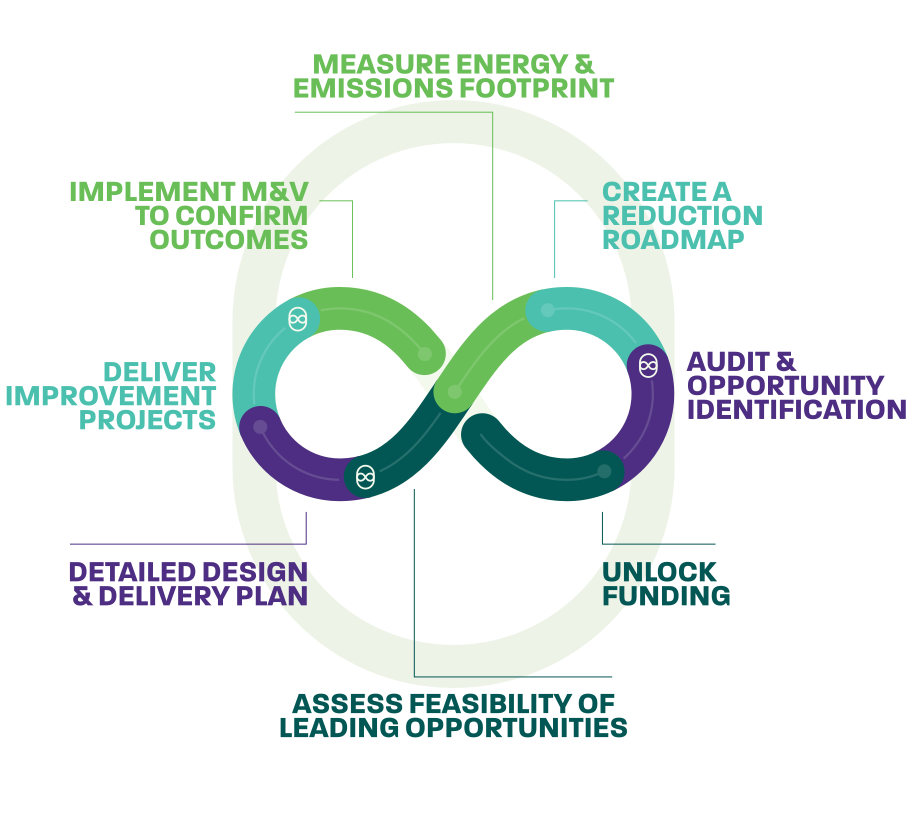
Short-Term: Develop Transition Plans, Business Cases, And Realise Quick Wins
In the short term, businesses should focus on building the foundations for long-term decarbonisation by understanding site energy use, identifying high-yield opportunities, cutting demand, and structuring an investment-ready transition plan:
- Data Collection & Metering: Establish accurate site energy baselines through electrical and thermal sub-metering, data logging, and monitoring of primary utilities and processes.
- Opportunity Identification: Conduct detailed energy audits to identify, quantify, and prioritise initiatives based on technical feasibility, emissions impact, and realistic ROI.
- Energy Efficiency Quick Wins: Implement low-cost, short-payback measures that immediately curb energy waste and improve the operating economics of future equipment upgrades.
- Feasibility Studies & Transition Planning: Evaluate future low-carbon technologies, grid infrastructure limits, and grant schemes to build a site-specific decarbonisation roadmap aligned with your asset replacement cycles.
Medium-Term: Build Momentum And Prepare For Major Investment
In the medium term, businesses should shift focus to implementing commercially proven projects that deliver substantial emissions reductions while preparing the ground for larger electrification and fuel-switching installations:
- Industrial Heat Pumps: Deploy industrial heat pumps and waste heat recovery systems to displace fossil fuels across low- to medium-temperature heating and washdown applications.
- On-Site Renewable Electricity: Install commercial solar PV and Battery Energy Storage Systems (BESS) to lower grid electricity charges, reduce Scope 2 emissions, and improve long-term energy price certainty.
- Project Detailed Design: Progress shortlisted projects through front-end engineering design (FEED), investment-grade business case development, and distribution network service provider (DNSP) connection planning.
- Infrastructure & Network Planning: Assess plant electrical capacity, transformer headroom, and network tariffs to ensure site power supplies can accommodate future electrified heating loads.
Long-Term: Deliver Strategic Decarbonisation Initiatives
In the long term, organisations can focus on eliminating their largest remaining emissions sources through major electrification, renewable fuel adoption, and strategic infrastructure projects. These large-scale projects are directly enabled by the planning, sub-metering, and grid preparation undertaken during earlier phases:
- Large-Scale Electrification: Deploy high-capacity electrification solutions, such as MW-scale heat pumps, industrial electric boilers, and thermal energy storage systems. Coordinate with network providers to commission necessary substation or supply upgrades to handle the load.
- Biomass & Biogas Deployment: Implement biomass and biogas boilers where reliable local fuel supply chains exist, site layouts allow suitable fuel handling and storage, and lifecycle project economics remain compelling.
Download The NSW Industry Decarbonisation Roadmap (56-Page Technical Report)
Want to benchmark your site against comprehensive process heat data? Access real-world levelised cost comparisons for heat pumps, electric boilers, and bioenergy across Food & Beverage, Meat Processing, and Manufacturing sectors.
(Fill in your details below to receive instant access to the technical report):
Refrigeration Strategy Blog
Accessing Crucial Financial Support And Funding
Financial incentives, environmental certificates, and grants can fundamentally alter project economics and should be factored in from day one. Identifying applicable schemes early strengthens business cases, reduces payback periods, and accelerates internal CapEx approval:
- Solar PV & Battery Incentives: Small-scale Technology Certificates (STCs) significantly reduce upfront capital for eligible solar systems. In NSW, solar and battery storage assets can generate additional commercial returns through the Peak Demand Reduction Scheme (PDRS).
- Energy Efficiency Certificates: Energy Savings Certificates (ESCs) in NSW and Victorian Energy Efficiency Certificates (VEECs) in Victoria provide ongoing financial returns for verified energy efficiency improvements, frequently bridging the gap to acceptable payback thresholds.
- Government Grants & Capital Funds: Keep active watch on programmes such as the ARENA Industrial Transformation Stream, the Australian Manufacturing Growth Centre (AMGC) SME Industrial Decarbonisation Fund, NSW Net Zero Planning Grants, and state-backed manufacturing funds.
- Alternative Funding & Delivery Models: Power Purchase Agreements (PPAs), Energy Performance Contracts (EPCs), and equipment leasing arrangements can eliminate upfront CapEx constraints and speed up deployment.
Funding rules and certificate values fluctuate, making continuous monitoring essential during your transition planning. Crucially, having "shovel-ready" engineering business cases and feasibility studies already complete is what determines whether your site successfully secures grant funding before rounds close.
Partner With DETA On Your Transition Roadmap
Overcoming the financial and technical barriers of industrial decarbonisation requires independent, vendor-neutral engineering advice.
Whether your facility needs an initial energy audit, an electrification feasibility study, or support preparing investment-grade business cases for grant co-funding, DETA’s process engineering team is here to help.
[ Contact Our Engineering Team ]
What we do